
Identify Who Owns a Johnson County Property
The fastest path runs from street address to assessment roll to newest recorded deed. Johnson County AIMS Online Mapping ties an address to its Tax Property ID, Kansas Uniform Parcel Number, legal description, and Owner 1 and Owner 2 entries. The parcel card is only the first stop. Next, test the deed index. Does the latest grantee match the roll? The Register of Deeds answers that. Keep the parcel number close at hand, because a shared name or a similar street can pull a property search onto the wrong land.
- Enter the situs address in AIMS and open the matching parcel.
- Read Owner 1 and Owner 2, then save the Property ID or KUPN.
- Search the newest transfer in the Register index and compare its grantee and legal description.
- If the grantee is a business, verify its formal name in the Kansas business-entity search.
This names the owner of record as county records state it today. A transfer recorded too recently for the roll, or a full title examination, still needs separate handling.
Read Johnson County Owner 1 and Owner 2
AIMS splits ownership into distinct Owner 1 and Owner 2 fields. It also keeps the situs address apart from Own Addr Line 1 and Own Addr Line 2. That separation matters. The situs marks the parcel location. The owner mailing lines show where county correspondence goes. An out-of-county mailing address proves nothing about residency, and a matching one proves nothing about occupancy.
The owner of record sits on the working county roll. A grantee is the party receiving an interest in a deed, and situs is the property location. A mailing address is only a correspondence field.
Also compare the legal description, Property ID, and KUPN. Names can shift. The tax roll may abbreviate a name or order it differently than the deed index, while the land description stays stable and confirms the match.
Where Johnson County Property Ownership Appears
No single screen settles every ownership question. The tax roll names the assessed owner. The deed index records transfers, and the GIS map ties each record to a parcel shape, so lean on whichever source maintains the fact you need.
| County source | Ownership clue | Best use |
|---|---|---|
| AIMS/Appraiser | Owner 1, Owner 2, mailing address, situs, parcel and value fields | Find the working owner-of-record entry |
| Register of Deeds | Grantor, grantee, document date and recorded instrument | Confirm the most recent transfer |
| AIMS map | Parcel shape linked with the property card | Prevent an address or same-name mismatch |
| Kansas Secretary of State | Business name, Kansas ID and resident-agent search | Check an entity name shown as grantee |
The listed owner may be one person, two people, a trust, a company, or an estate representative. None of these sources names the occupant.
Confirm a Johnson County Property Owner by Deed
AIMS is the practical starting point. After a recent closing, though, the newest recorded conveyance is the better check. Search the AIMS owner name as a grantee in the Register of Deeds document system. Compare the deed's legal description with the parcel card. A name match alone is not enough. The county describes legacy recorded-document information from 1920 through 1987 and a subscription index from 1920 forward.
A fall 2026 Enterprise Records Management transition is planned. Image behavior may differ from the legacy TIFF system. New legacy subscriptions stopped July 1, 2026. If the web route fails, the Register FAQ points to a courthouse terminal, and a written KORA request can seek any existing non-exempt record.
Note: A recorded deed confirms the indexed transfer, but only qualified title work can resolve competing interests or unrecorded claims.
Trace an LLC or Trust Owner in Johnson County
Entity owners need exact wording. Copy the name character for character. When Owner 1 lists an LLC, corporation, trust, trustee, or personal representative, suffixes and trustee language can decide whether a deed-index query succeeds. Try the tax-roll form first. A shortened root with the documented percent or underscore wildcard may help if the portal permits it.
The Kansas Business Entity Search accepts a business name, Kansas Business ID, or current resident agent. It can clarify which entity a deed names. It cannot turn an agent or officer into the landowner. Trust details may remain in the deed, probate file, or other recorded instrument rather than the business database. The official business-search screen illustrates the separate entity step:
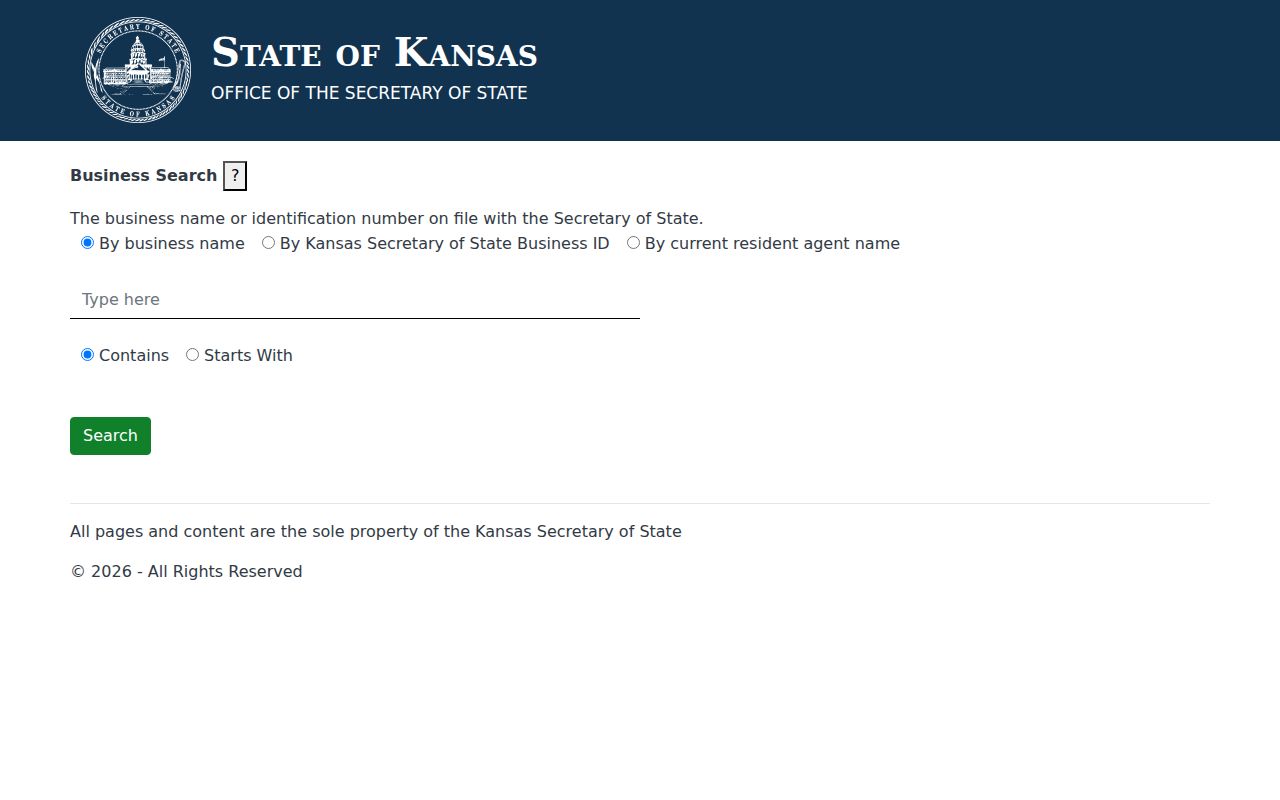
Use that result only to standardize the entity name, then return to the Johnson County parcel and deed records.
Separate the Johnson County Mailing and Situs Fields
The owner mailing line is not proof of residency. AIMS labels these as separate data, yet the mailing entry may point to a management office, trustee, post-office box, or another home entirely. The situs field anchors the land. The mailing field exists for county notice and correspondence.
For purchase due diligence, copy both fields exactly and note the date checked. Then verify the parcel ID and the latest deed. That disciplined record card is more useful than a name dropped into a general web search, because it preserves the county's link between person or entity and land.
When Johnson County Ownership Records Lag
Johnson County publishes no fixed refresh interval for AIMS. It also names no typical lag between a closing date and a changed tax roll. That gap is documented. Treat it as a reason to verify, not to guess. When a sale has just closed, pull the newest deed from the Johnson County deed records. Compare its grantee, recording date, and legal description against the AIMS parcel entry before trusting the owner of record.
Recent-sale check. The roll is a current tax snapshot, but the newest recorded deed may be more current after a just-completed transfer.
Jot down the date of your search. Knowing when you pulled the parcel record helps explain later gaps, whether the delay comes from routine processing or the county's portal transition during a Johnson County ownership check.
Johnson County Has No Listed Fraud-Alert Signup
Johnson County does not currently offer a property-fraud alert service. The Register of Deeds FAQ says so plainly. Borrowing a signup from another county will not work. Assuming an alert exists somewhere is also a mistake. Owners can still protect themselves by reviewing their AIMS parcel and recorded instruments, keeping closing papers, and contacting the Register of Deeds if an unfamiliar filing appears in the deed records. That local gap makes direct record checks matter more. A mailed solicitation styled like a government notice proves nothing, and any paid copy offer deserves a comparison against the Register's official copy options.
Limits on Who Owns a Johnson County Property Search
The public tax roll can name an owner of record. That is real value. But it cannot confirm who occupies the site. It cannot show whether every ownership interest is clear. It also cannot show whether an unrecorded claim lingers outside the deed records. Kansas Safe at Home adds another wrinkle, giving qualifying victims substitute-address protection. So a mailing address in a Johnson County property search never paints a full picture of where a person actually lives.
Lawful use. Johnson County owner records support due diligence, boundary research, and civic review. Never use them to stalk, harass, intimidate, or harm a person.
Need the record as it stands now? The Johnson County current owner guide walks the roll-to-deed check. A purchaser who wants legal certainty should still retain a title professional instead of trusting an online name alone, since parcel data alone cannot guarantee clean ownership of a Johnson County property.