
Read Johnson County Tax Records
Two offices matter here. The Appraiser holds valuation data for Johnson County parcels, while the Treasurer keeps the billing side, so a full tax-year picture means reading both sets of property tax records.
| Field | What It Shows | Where |
|---|---|---|
| Appraised value | County fair-market estimate | Appraiser/AIMS |
| Assessed value | Statutory share used for tax | Appraiser/AIMS |
| Property class | Classification that sets the ratio | Appraiser/AIMS |
| Bill and receipt | Amount due, paid, or delinquent | Treasurer |
| Taxing unit | District and levy context | AIMS and tax bill |
Assessment rates depend on class. Residential property in Johnson County is generally assessed at 11.5 percent of appraised value, and commercial or industrial property at 25 percent. Assessed value is not a likely sale price. Because the bill layers levies and adjustments onto that base, it works as a tax document, not a private appraisal of the parcel.
Look Up a Johnson County Bill
The Treasurer tax-bill search lets you look up a Johnson County bill by Address, Parcel ID, Quick Ref ID, or Name. Parcel ID or Quick Ref ID is the better choice, since an owner with several parcels can otherwise lead you to the wrong tax record.
- Search by address, Parcel ID, Quick Ref ID, or owner name.
- Open the current bill and compare earlier bills or receipts.
- Match its identifiers to the AIMS property card.
- Review payment status, delinquency, and posted foreclosure information.
- Assessed value
- The statutory share of appraised value used for tax.
- Mill levy
- The rate applied to assessed value.
- Property relief
- A qualifying program that can reduce tax burden.
- Tax lien
- A legal claim tied to unpaid tax.
See Johnson County Tax Search
The official Johnson County tax-bill portal shows the four public starting fields.
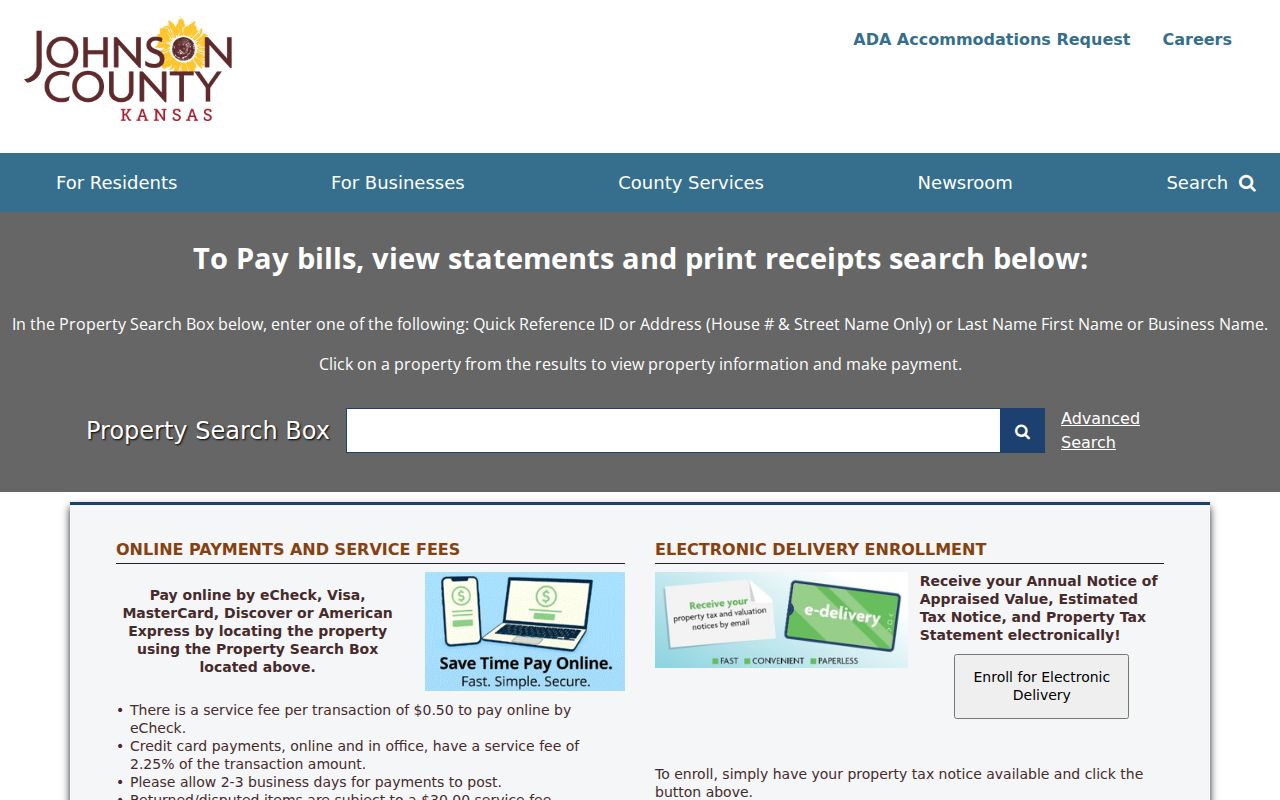
Save the parcel key from your search and cross-check it against AIMS before trusting any payment status.
Johnson County's Tax Calculation
The calculation starts with the Appraiser. The office estimates fair-market value and applies the Kansas assessment percentage for the property's class. The Treasurer then figures the tax from assessed value and the combined levy. Any credits or adjustments are applied first. Levies vary. Taxing units split across city, school, and special-district lines. Two nearby Johnson County parcels can carry different rates.
A mill equals one dollar of tax per thousand dollars of assessed value. Knowing that makes a bill easier to read. The bill itself remains the authority on what is due for the year. Rely on the county's published value, class, and levy figures. Do not rebuild a bill from a neighborhood estimate.
Pay Johnson County Property Tax
Real-estate tax in Johnson County generally comes due in two halves. The first half is due on December 20. The second is due on May 10. Paying everything with the first installment is allowed too. For online payment, the county lists a $0.50 eCheck charge. It also lists a 2.25 percent card charge.
Receipts and prior bills document what was paid. Still, confirm the portal posted the right parcel and tax year. A late or returned payment can change the status after you printed a screen. So a saved copy is not the final word.
Johnson County Relief Programs
Kansas programs the county points to include Homestead. SAFESR is another option. The Senior or Disabled Veteran property-tax refund rounds out the list. Johnson County has also described a 2026 pilot relief program tied to income qualifications. Relief works separately from the base appraisal. Getting a refund does not rewrite the parcel's legal description or its ownership chain.
Rules and application windows shift. For the current form, required proof, and filing date, use the official county and Kansas Department of Revenue materials. Do not assume that age, disability, or long ownership alone qualifies a claimant.
Johnson County Delinquent Tax Trail
Property tax records can flag delinquency long before a parcel reaches foreclosure. Johnson County describes a delinquent list published after July 31 and a later tax-foreclosure process. A listing is a clue, not a verdict. Taxes may be redeemed, or the case may shift.
The Treasurer's tax-foreclosure page and the court record answer different questions. The auction list goes out about 30 days before a sale and runs in a newspaper once a week for three weeks. Before concluding anything about ownership, check the court confirmation and redemption steps.
Historic Johnson County Tax Rolls
County Archives holds Johnson County tax rolls from 1862 through 2007. Those older records can place a name or tract in a specific year. The current portal lacks that depth. Library directories, maps, and newspaper collections can round out the household or neighborhood picture.
A tax-roll name is only an ownership lead, though. Confirm any transfer through the deed books. The Register of Deeds index works too. Archives research may take an appointment, a focused request, and extra retrieval time.
Payment Under Johnson County Protest
A property owner who skipped the spring appeal has another option. The payment-under-protest route lets a taxpayer contest a valuation. The contest happens at the time the tax bill is paid. The county sets its own form and deadline for this process. The protested amount must be handled separately. It stands apart from any claim that the Treasurer posted a payment incorrectly.
Evidence works best when it speaks to the property's condition on January 1. Repair estimates carry weight. So do photographs, comparable sales, and corrections to size, class, or features. All of it works better than a simple complaint that the bill climbed. Owners should also keep copies of everything filed and paid.
Get Johnson County Tax Records
The web portal is the quickest route to bills and receipts. For Johnson County records beyond that, the Property Tax division handles payment and delinquency questions. The Appraiser covers parcel facts and valuation appeals. Mail and counter service still helps when an online result is unclear. It also helps when a certified response is needed.
When an existing nonexempt record is not posted online, a focused KORA request can name the parcel, year, and record sought. The county answers within three business days. Retrieval or review can run longer. Actual costs may apply.
Challenge a Johnson County Value
The Appraiser values property as of January 1 and sends annual notices by or on March 1. An owner may seek an informal review and then use the county's formal appeal route. Useful evidence can include comparable sales, photos, repair estimates, a recent appraisal, or facts showing an error in the parcel record.
Payment under protest is a later payment route and is not the same as the spring valuation appeal. Follow the date on the current notice because filing windows are tied to the assessment cycle.
Act from the notice. File within the current county deadline and keep evidence tied to the January 1 valuation date.