
Reconstruct Johnson County Former Owners Backward
The newest deed hands a researcher two names. The grantee is the newest link. The grantor is the earlier one. Search that grantor as an earlier grantee, confirm the same legal description, and repeat, a loop the worksheet traces without inventing a sample parcel.
| Transfer point | Grantor to grantee | Document | Citation |
|---|---|---|---|
| Newest deed | Latest seller to latest buyer | Recorded deed type | Instrument or book/page |
| Prior deed | Earlier seller to that seller | Read the indexed label | Earlier instrument |
| Older book | Repeat on the same land | Deed-book entry | Volume and page |
| Supporting year | Tax-roll name as a lead | Assessment record | Roll year and collection |
AIMS supplies the current owner of record, parcel ID, KUPN, and legal description. Those fields identify the land itself. Deeds still form the transfer chain. Keep spelling variants, because deed indexing can differ from tax-roll order.
- Grantor
- The party conveying an interest.
- Grantee
- The party receiving it.
- Reverse index
- The name route used to find an acquiring instrument.
- Chain of title
- The linked sequence of recorded interests in the same land.
Johnson County's Online Chain Has a 1920 Boundary
Johnson County's online deed chain has a 1920 boundary. The Register's document library covers recorded-document information from 1920 through 1987. Plat images run from 1866 forward. A subscription index covers 1920 to the present.
Free online images for every year are not guaranteed. The old system used TIFF files and dated browsers. Johnson County stopped new subscriptions on July 1, 2026. Enterprise Records Management is anticipated in fall 2026, so a blank image during the change may reflect an access problem rather than a missing deed.
The Register of Deeds FAQ spells out the office-terminal and copy route a former-owner researcher may need:
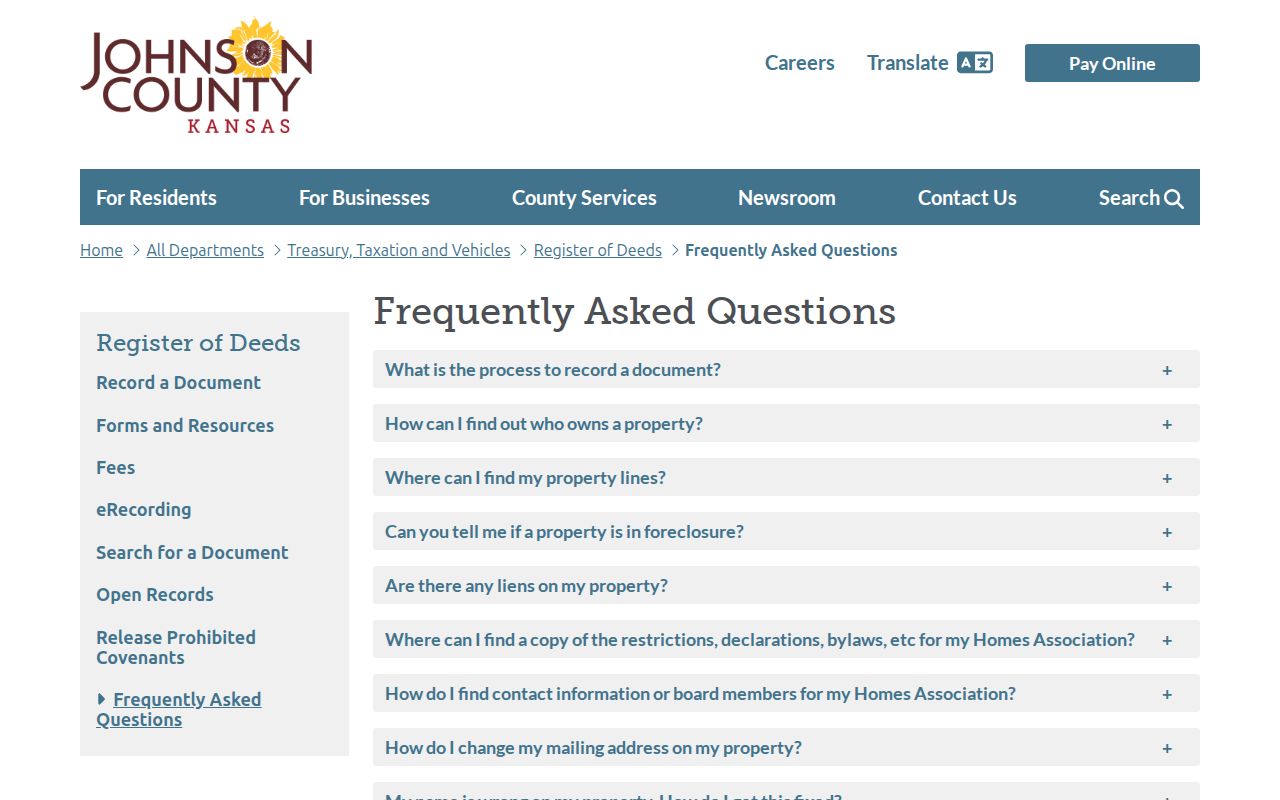
That official guidance explains why the courthouse terminal, records request, and coming ERM workflow remain part of the chain. The trail does not end at a keyboard.
Online cutoff. At the 1920 index boundary, continue through deed books, Archives, KSHS, or the courthouse instead of ending the former-owner chain.
Carry Johnson County Previous Owners Into Archives
Kansas Historical Society holdings date the start of Johnson County deed records to 1857. The holdings also include early probate and civil series. Johnson County Archives holds tax rolls from 1862 through 2007. Its delinquent list runs from 1858 through 1861.
A roll name is a dated lead, not a transfer. Use it to narrow a year, then locate the instrument, probate file, or plat. Archives works by appointment. A collection-level request often beats assuming an old volume is searchable online.
Walk the Johnson County Deed Chain in Reverse
Use the Register of Deeds index. Keep the current legal description beside every query. Names, marital status, trustee wording, and corporate suffixes may change while the parcel stays the same.
- Start with the latest deed affecting the identified parcel.
- Read the grantor exactly and note the document type and date.
- Search that grantor as an earlier grantee and compare the land description.
- At the online boundary, carry the last sound citation to older books or archives.
- Warranty deed
- A conveyance with different promises from a quitclaim deed.
- Quitclaim deed
- A conveyance of whatever interest the grantor holds, without the same warranties.
- Legal description
- The land wording that outlasts many street-address changes.
Not every transfer is a market sale. Probate, beneficiary-deed, estate, and trustee events can interrupt a simple personal-name chain, so follow the actual instrument instead.
Probate Can Interrupt Johnson County Prior Owners
A deceased owner's interest may pass through an estate, beneficiary deed, executor, or court-linked record. The next instrument may name a representative. That person appears where the former owner was expected. Search the legal description and probate party names together.
Johnson County District Court records can yield a case lead. A docket never replaces the recorded land instrument. The deed and parcel reference keep the history tied to the right tract.
Note: A break in the name chain may signal an estate or trust event, not a missing owner or destroyed record.
Tax Rolls Add Johnson County Past-Owner Snapshots
Tax rolls spanning 1862 through 2007 show which name was assessed in a given year. That narrows when ownership changed. A roll cannot prove the transfer date. It also cannot prove deed terms. Use its dated names to narrow former owners, then return to the recorded chain.
Johnson County Library adds directories, maps, indexes, photos, and newspapers. A directory occupant is not automatically the owner. Owners and occupants can be different people. Correlate any street entry with a roll, deed, and plat before naming a prior owner.
An Unusual Johnson County Address Clue Survived in a Capsule
Demolition crews found a 1951 courthouse time capsule. It was opened in 2022. Inside were a trial docket, a newspaper microfilm reel, and a 1950 Olathe phone directory. The find shows how address clues can survive outside the deed system.
It proves no ownership. It also does not show that county deed books were lost, so use its directory and docket references only to shape an Archives query, then return to land records for the transfer proof.
Old Johnson County Addresses Need Land Descriptions
Old records abbreviate streets. They may use lot and block, or describe a tract by section, township, and range. AIMS supports legal descriptions, plats, neighborhoods, map numbers, intersections, and T-R-S or S-T-R keys. Those searches reconnect an old deed with today's parcel.
ZIP alone is weak. Postal geography crosses city limits, so lean on the plat and legal description instead, the safer thread through annexations and address changes.
Know Where Johnson County Ownership History Ends
No verified fire or flood loss exists in the official sources. Skip the disaster story when a link goes missing. Index coverage, variant names, estates, replats, access gates, or another custodian are more supportable causes.
Evidence limit. Former-owner research supports house history and due diligence, but only linked instruments build the chain. Never use the findings to harass a living person.
Need one instrument in hand? The Johnson County deed records page covers access to a single located deed, while this page stays focused on tracing back through time.